



























Review for Soul Eater: Part 1
Introduction
Oh, please, not more shonen! That was my instinctive response when Soul Eater first dropped into my in-tray. Too much of anything, even in anime isn't necessarily a good thing, and if there is one genre that is done to death these days, it's shonen, those stories, typically long-running anime shows, that are aimed at the young, teen, male market. You need three ingredients, an epic storyline (or an endless one) to justify the length, you need a world that is complex and intricate (or just full of unique terminology and jargon that will make the show exclusive to its target audience), and you need a protagonist, usually young, male, brash, and determined, levelling his way up through the storyline. And when it comes to shonen shows in the UK, it's Manga Entertainment that rules the roost, with the teen male audience as key to their profits today, as the 'video nasty' fans were back in the old days of Manga Video. Most shonen shows are bland and forgettable, like Blue Dragon and MAR (remember those?) They were so bland that Manga had to stop releasing them in the UK, because Viz had stopped dubbing and releasing them in the US. Then there are the big hitters, the shows that are good, but not consistently so, but have a fan following and a storyline that can be described as anything but bland and forgettable, and in the UK they are Manga's mainstays like Naruto and Bleach. Once in a while a shonen show will transcend its genre, and appeal to a far broader church. Claymore was one such show, Death Note is another, and Full Metal Alchemist is probably the best of them all. It's no surprise that Manga will be releasing the FMA remake series later this year.
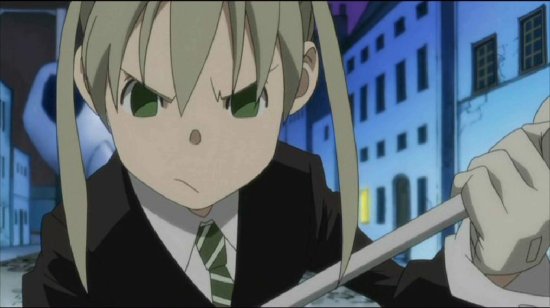
But I do long for a little variety in my anime, a little reminder that there is more to the medium than just the teenaged male viewer can appreciate, and I'm certainly not constantly looking for the next Buso Renkin, or D-Gray-Man. So when I read Soul Eater's blurb, with its tale of shinigami (my eyes rolled as I recalled Death Note and Bleach) attending an academy for soul reapers (my eyes rolled out of my head as I recalled 51 discs of Naruto's ninja education) you can imagine my heart sinking faster than the Titanic. The fact that Soul Eater isn't one of the interminable series was small comfort; it's got a set number of episodes, although 51 are daunting enough. But then I put the first disc into my player, and I started watching it. I must admit that the opening credits made me smile, but opening credit sequences usually get a fair amount of yen spent on them. But that smile stayed put as the episode started, and in fact grew into a grin as the show progressed. 13 episodes later and I'm still grinning like an idiot. Maybe I can stand a little more shonen after all.
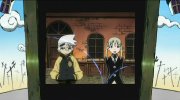
Now pay attention, as there will be a quiz later. Soul Eater is set in a world that was once terrorised to submission by the darkest of souls. Evil people's souls gradually turn from bright and shiny, into warped red Kishin Eggs, and it's the Kishin that go ahead and cause trouble. It was the shinigami that saved the world by reaping these Kishin, and by reaping the evildoers before their tainted souls can hatch. Chief among them was Death himself, but the ultimate personification of mortality can't handle all this by himself, which is why he's now the headmaster of the Death Weapon Meister Academy. Weapon Meisters are those people who have the skills and talent to reap souls. They do this by using human weapons, partners who literally transform into weapons to reap souls. To graduate and become a shinigami, a Meister and his weapon need to reap 99 evil souls, and one witch, after which the weapon will become a fully-fledged Death Scythe. Soul Eater introduces and follows three unconventional partnerships, Maka and Soul Eater, who aspire to ultimate coolness, Black * Star and Tsubaki, who are hampered by Black * Star's ego, and the son of the Grim Reaper himself, Death the Kid, and his twin weapons, Patty and Liz, for whom symmetry is the ultimate goal.
Manga Entertainment presents the first 13 episodes of Soul Eater across two discs, and you can read the episode synopses on the next page. If you want to avoid those spoilers, you can go straight to page 3 for the verdict, where there no doubt will be more spoilers anyway.
Picture
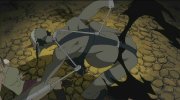
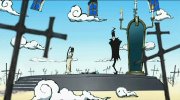
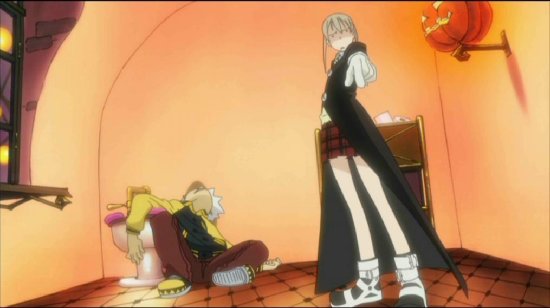
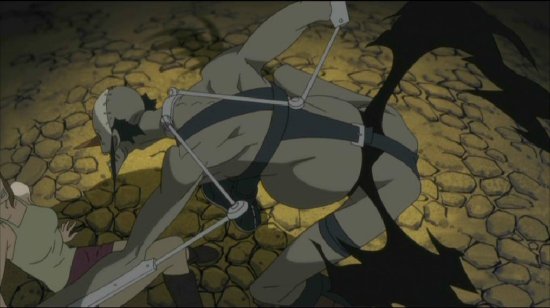
Soul Eater gets a 1.78:1 anamorphic transfer, which as usual for television anime is an NTSC-PAL standards conversion. Having said that, this is the best such conversion I have yet seen, with only a slight judder and interlacing artefacts evident, which you can never get away from with such conversions. What Soul Eater does offer is a brilliantly sharp and clear transfer, of such clarity that it must be taken from an HD source. I have yet to see a television anime as sharp, detailed and well defined as this one. It's a good thing too, as with studio Bones behind the animation, the transfer really does the vibrant, fluid and energetic animation justice. Also, Shinji Aramaki of Bubblegum Crisis fame is behind the show's concept designs, and Soul Eater is a quirky, memorable visual explosion of an anime, stylish and possessing a punk sensibility, which puts me in mind of FLCL, although nowhere near as intense. It's still the kind of visual aesthetic that you have to strap yourself in for.
Sound
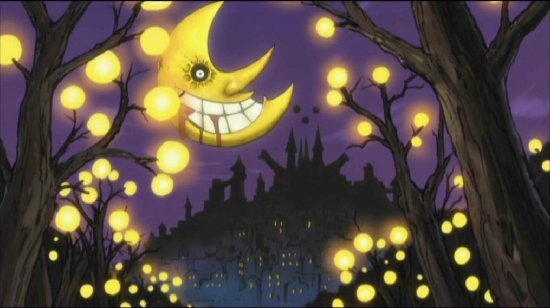
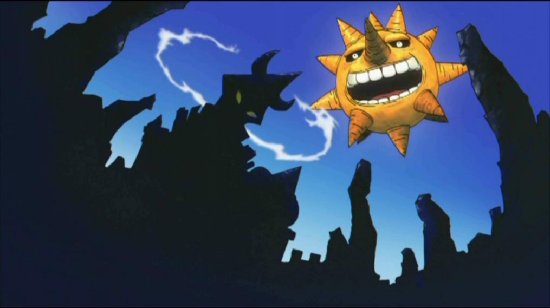
The sound comes in DD 5.1 English and DD 2.0 Japanese options, with translated English subtitles or a signs only track. The surround is quite nice given all the action, but the minute you hear the evil looking CG sun in the sky, evil-laughing his head off, you realise that you're in for something of an audio treat. Soul Eater is definitely a little left field in its sound design. The music comes from Taku Iwasaki, of R.O.D. and Witch Hunter Robin fame, and it definitely suits the show well. He also appears to have taken some inspiration from British pop music, as I'm sure I heard hints of Mis-teeq and The Chemical Brothers in some of the music. The English dub is more than acceptable, courtesy of Funimation, but I have taken a liking to the Japanese track more than usual this time, as I find that Maka's voice actress is particularly quirky, and suits the pugnacious heroine down to a T.
The Episodes
Disc One
1. Resonance Of The Soul - Will Soul Eater Become A Death Scythe?
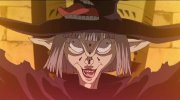
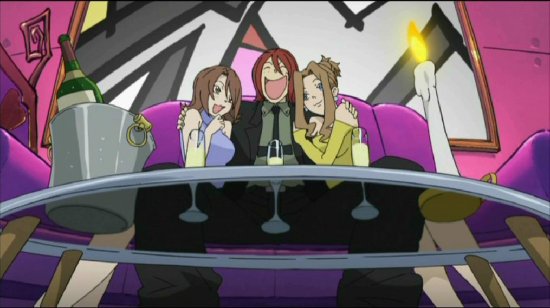
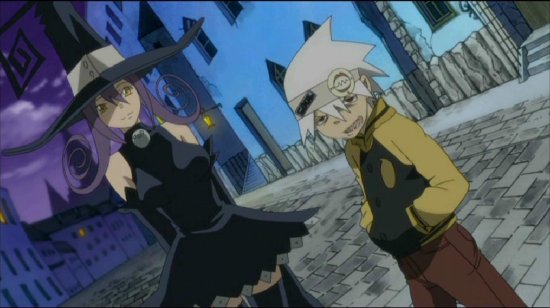
Maka and Soul Eater have a great partnership, and they're literally scything their way through the evil community. They've already notched up 99 Kishin Eggs, and all they need now is the soul of a witch to make Soul Eater a Death Scythe just like Maka's estranged father, and Maka can be a shinigami just like her mother. But the rules are clear, if they make one mistake collecting the witch's soul, then it's back to square one. Their first mistake is targeting Blair the Witch, a piece of magical hotness that gives Soul nosebleeds of lust.
2. I Am The Star! - The Big Man Is Showing Up Here?
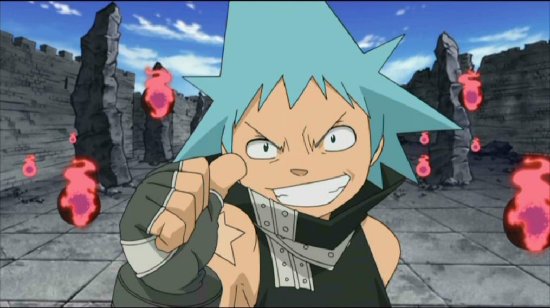
Black * Star has skill; there's no denying that. The trouble is his ego, which is almost as loud as he is, meaning that the tolerant Tsubaki is the only weapon that can bear to work with him. Black * Star wants to be an assassin, impossible when he's crowing his greatness at the top of his lungs, and one reason why he and Tsubaki are yet to collect a soul. But they have a chance to solve their problems all in one go. Al Capone and his men are collecting souls for themselves, powering up their spiritual strength, and they've targeted a witch named Angela to complete their spiritual upgrade. Al Capone, his men, plus Angela the Witch equals 99 + 1, enough to let Black * Star graduate in one go. He hasn't counted on Angela's bodyguard Mifune though.

3. The Perfect Boy - Death The Kid's Magnificent Mission?
As if the son of Death would ever need to attend the Academy. He's a full-fledged Shinigami, wielding his twin guns Liz and Patty to devastating effect. Except that he has obsessive compulsive disorder, and needs symmetry in all things, which is how so many of his targets escape from him. But Death the Kid needs the 99 + 1 target as well, as he aims to create the perfect weapon. His chance arises when a necromancer appears in Egypt, raising the dead in the pyramid of Anubis. It's the perfect mission, after all pyramids possess the perfect symmetry. If only he can remember if the paintings in his home are hanging straight.
4. Engage The Witch Hunter! - A Remedial Lesson In The Graveyard?
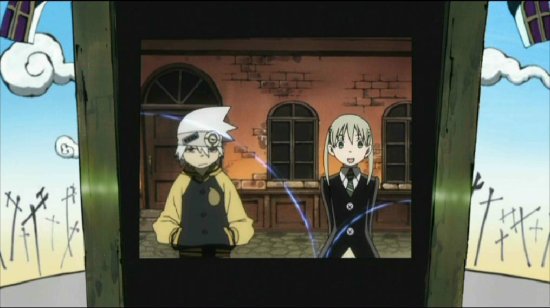
It's all change in Class Crescent Moon at the Death Weapon Meister Academy. Their previous teacher Sid has passed on, and their new temporary teacher is none other than Death Scythe, to Maka's disgust. But their previous performances have been lacklustre. Death calls them to his office and tells them that they have to take a remedial class, and if they fail they will be expelled. So it is that Maka and Soul Eater, Black * Star and Tsubaki are in a graveyard, hunting for a zombie and the necromancer that raised him. The zombie turns out to be none other than their former teacher Sid, and as for the mastermind, that's none other than Dr Franken Stein, the top former Weapon Meister, and the first partner of Maka's father Death Scythe.
5. Shape Of The Soul - Enter The Ultimate Meister Stein?
They don't know it, but they've bitten off more than they can chew. Stein may be clumsy, may be obsessed with his own ego, and may be blinded by his desire to experiment on souls, and he may have a screw loose in his head, no really, he has a screw in his head that he keeps tightening, but he can read his foes like an open book, and while the precocious Maka and Soul may have mastered the Witch Hunter manoeuvre, it has no effect on Stein. Black * Star may be able to project his soul strength without needing the amplification of a weapon, but Stein just shrugs it off and returns it tenfold.
6. The New Student: Kid's First Day At The Academy - Will It Be An Entrance To Remember?
Watching that battle from afar was too much for Death the Kid, he's decided to join the Academy even though he doesn't have to. Black * Star and Soul Eater decide that they've got to nip the nepotism in the bud. Oh, Soul and Black * Star have decided that as they have equally grand egos, they'd be better off partnered with each other than with the two who really match their souls. As for Maka and Tsubaki, they've been lamenting their new teacher. Dr Stein has been teaching nothing but dissection since he started work. But Stein takes a break from his latest victim to teach Maka and Tsubaki about mismatched souls versus souls that are perfectly attuned. That will be Soul and Black * Star trying to fight Death the Kid and Liz and Patty then.
7. Black-Blooded Terror - There's A Weapon Inside Crona?
Maka and Soul are on a trip to Italy, but it's not a vacation. They are after the soul of killer Sonson J, as part of an extracurricular lesson. But there is more going on than just a simple mission. Medusa the Witch watches from above, as a Meister named Crona goes hunting in the city with the weapon Ragnarok, only their targets aren't Kishin Eggs, they are normal souls. Maka realises this, and sets out to stop Crona, only she's bitten off more than she can chew. Maka realises her mistake in challenging Crona far too late.
Disc Two
8. Medusa The Witch - The One Who Possesses A Great Evil Soul?
It's no wonder that Maka and Soul had such problems, as they were totally outclassed by an enemy beyond their ken. Even Stein has a hard time when he shows up, especially with the Demon Sword and Crona just one step away from becoming a fully-grown Kishin. And when they finally see the witch behind the attack, they realise just why. Medusa has seen enough, and she takes her experiment and leaves. Back at the Academy, Maka frets while Soul undergoes an operation. But it isn't just the wound, Soul has been infected by Ragnarok's black blood, and no one is sure exactly what that means. He's in good hands though; the school nurse is taking care of him… Nurse Medusa…
9. Legend Of The Holy Sword - Kid And Black Star's Great Adventure?
Soul is recuperating in the school infirmary, while Maka is berating herself for her failure. You'd think that a heart to heart chat would sort her out, but when it's her father that is supplying the heart to heart; it promises to be a tense conversation. Meanwhile, Black * Star and Death the Kid have found a book on the legendary Excalibur in the library. That seems to be a suitable weapon for heroes such as them, and when they hear that not even the great Franken Stein could master such a weapon, the challenge is laid down and accepted. They will go out and obtain the mythic sword themselves. There's a reason why no one has obtained it though.
10. The Enchanted Sword Masamune - Break The Soul Procession: A Heart Sings In The Rain?
Tsubaki has a mission from Death himself. She has to stop Masamune, the enchanted sword, a weapon on the verge of becoming a Kishin. Masamune is a particularly insidious foe, who uses his victims' fears against them. The thing is that she hasn't been able to tell Black * Star just yet. Black * Star has his own secrets. When they come to Needle Village, where Masamune is suspected of being, the animosity of the villagers against Black * Star bears explanation. The question remains, will Tsubaki be able to tell her Meister the truth about her relationship to Masamune.
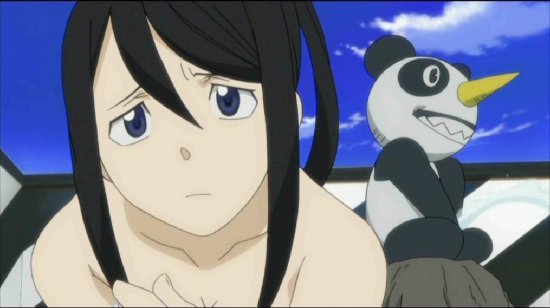
11. Tsubaki The Camellia Blossom - What Lies Beyond The Grief?
Tsubaki has to face Masamune is a puppet world of his own imagination, and while her body remains comatose in the village, Black * Star waits patiently, and supports her in her internal battle for control of her own mind. It isn't easy waiting when the villagers keep hitting you over the head with sticks.
12. Courage That Beats Out Fear - Maka Albarn's Great Resolution?
It's a period to reflect and relax for the students of the DWMA, and Maka, while still dealing with her perceived failure with her partner Soul, is still planning a party for him now that he is recovered, and a celebration for Black * Star and Tsubaki on the successful completion of the previous mission. She still needs advice on how to deal with Soul now, and it's good that Dr Stein is there with some. But the real hard days work comes for Medusa, who attends the Witches' Mass, only to pick up a couple of enemies who don't like the fact that she's snuggled up to the bosom of their sworn enemies. Erika Frog and Mizune want to do away with the danger, but for Medusa, it's an opportunity to advance her experiment with Soul one step further, and arrange the escape of a certain prisoner.
13. The Man With The Magic Eye - Soul And Maka's Diverging Soul Wavelength?
The prison escape commences, and Magic Eye Man isn't the sharpest tool in the shed, as Erika Frog discovers to her bemusement. But he does have one or two talents that will prove useful as Medusa contrives a test for Soul Eater. Soul and Maka are undergoing a test anyway, as their fraught relationship is making working together hard, and Stein suggests a procedure that may help. But get it wrong, and they will never be able to match Soul Wavelengths again, their partnership will be over. It doesn't look good when Soul and Maka, Black * Star and Tsubaki are sent to London. It's there that they will face Magic Eye Man, and Maka will learn that it's hard to reap the soul of an immortal, and it's even harder when she can't even pick up Soul's scythe form anymore.
Extras
Both discs get simple and effective presentation, static menus and jacket pictures.
Disc 1 has an audio commentary to accompany episode 7, featuring the ADR director Zach Bolton, voice of Maka, Laura Bailey, and voice of Soul, Micah Solusod. It's your typical Funimation gossip track, but it's mellow and gentle about it, so it's easy to listen to.
Disc 2 gets the textless credits.
You'll also find the Soul Eater Late Show here. These are normally those 90-second skits that you find tacked onto the end of an episode, Here all thirteen are collected into one 21-minute Play-All chunk, although you can select them individually. Each bit comprises fan service, comedy skit, preview and art gallery, and some of them are quite entertaining.
Conclusion
There are two types of reluctance that I faced with Soul Eater. My initial reluctance to watch it was because I thought it would be 'another' shonen action show. It turns out to be anything but. Then at the end, I became reluctant to watch the final episodes, as I wanted to extend the experience out as long as possible, review deadline notwithstanding. I've come to look on the unveiling of each new episode as the opening of a new gift at Christmas, and as I came closer and closer to the end of the second disc, I became more and more reluctant to unwrap that final episode. It was only the arrival of the next set of Soul Eater check discs that got me through (Manga are releasing the first two sets just a month apart, but you'll have to wait longer for the final two). In other words, I liked Soul Eater, I liked it a lot, and I haven't felt thrilled in this way about a new anime in quite a while.
There's no denying that Soul Eater is a shonen show, replete with the levelling up clichés and the epic storylines, as well as the brash young heroes and heroines and the regular fight sequences. But Soul Eater has a fresh style, a punk sensibility, and a level of energy that makes it transcend its genre. It also has a tongue-in-cheek approach to storytelling that keeps it on the edge of parody, but never quite ventures into spoof territory. These are writers and animators who are having a whole lot of fun with what they are doing, revelling in just how far they can push the envelope. It's the animation style that makes it all so fresh and original. I guess you could describe its visual mayhem and intensity as FLCL-lite. After all, FLCL packed all its inventiveness into six perfectly formed episodes, the creators of Soul Eater have to stretch it out to 51 episodes, but it definitely has that same rebel vibe to it.
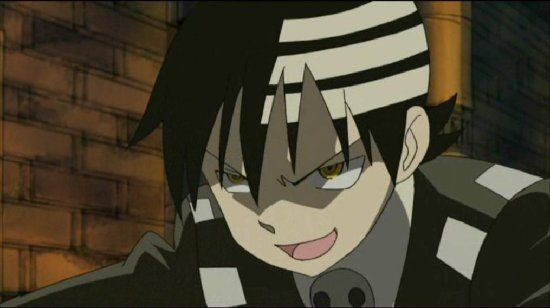
The story is pretty par for the course when it comes to the genre. It's a good guys versus bad guys set-up, with plenty of magical techniques and weaponry on both sides. On one side you have the good guys, the shinigami, who reap evil souls and keep the world a nice, happy place. Death, is the head shinigami, although a far more comedic and humorous a personification, even more than the Grim Reaper encountered in the Discworld novels. He's started a school for reapers, to make sure the next generation have a hand in keeping the world safe. It's an entertaining concept, with levelling up at the heart of it. Meisters and Weapons have to be partnered together to become the ultimate reapers. Meisters are those who have the talent to wield the weapons, and the Weapons are humans (literally turning into weapons) whose souls match with the Meisters, to create the perfect reaping team. The bad guys are the evil souls, and the witches, and it's through literally devouring the evil souls that the Weapons get to level up. Of course the ultimate foe are Kishin. As the show starts, we're told that the souls of evil people have started down the road to becoming Kishin Eggs, and when those eggs hatch, chaos is unleashed across the world. But as the story unfolds, it turns out to be nowhere near as simple as that.
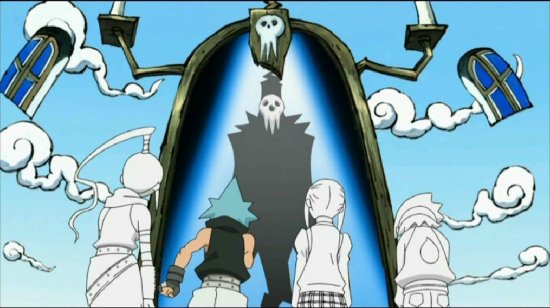
While the animation style and the music play a big part in making this show special, it's really the characterisations that entertain, beginning of course with three, really quite different Meister and Weapon teams. The central characters are Maka and Soul of course, with Soul obsessed with being 'cool', and his scythe form as wielded by Maka serving that purpose well. Maka has a stubborn streak that is really endearing, and she can deal just as much violence to her partner at times as she can to her foes. She also has a rather odd relationship with her father Death Scythe, who has just divorced her mother, but is trying to keep the fatherly role with his daughter, hampered by his womanising ways. Then there is Black * Star and Tsubaki. Black * Star is brash and egotistical, vocally confident of his own abilities to the extent that he makes Naruto look like a shrinking violet. In fact, he appears to be a parody of the bright orange ninja, in that he wants to be an assassin, sneaky and furtive, but always messes up by announcing his presence at the top of his lungs. Tsubaki is a long-suffering, understanding and gentle soul, the only sort of person who could long tolerate Black * Star, but she is versatile as a weapon, able to change into multiple forms.
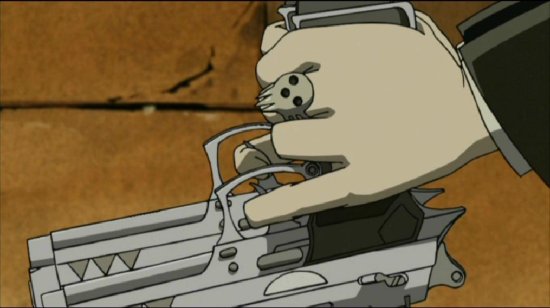
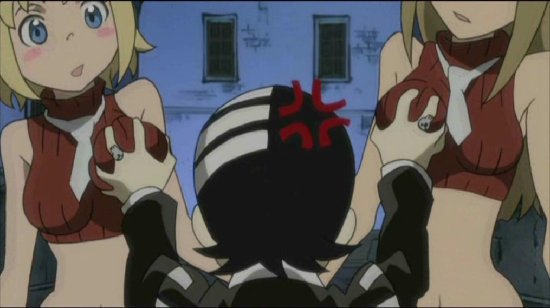
Then there is Death the Kid, who at this point is clearly the comic relief, even in amongst characters written with comedy in mind. He's the son of Death, with all the inherited skills and talent that implies, except that he has a serious case of obsessive compulsive disorder, is meticulous and anal about symmetry, will drop something important if he suddenly remembers that he hasn't properly folded the toilet paper, and the fact that the breasts of his twin weapons Patty and Liz aren't of equal size is of constant irritation to him. He alone has two weapons, sisters Patty and Liz, who transform into soul-reaping guns. Protagonists in John Woo movies may hold their guns sideways, but I bet none hold them upside down, pulling the triggers with their pinkies. Patty's happy-go-lucky and cheerful, while Liz is a little nervier and more serious than her sister, it's also Liz who'll smack Kid when he gets a little too anal.
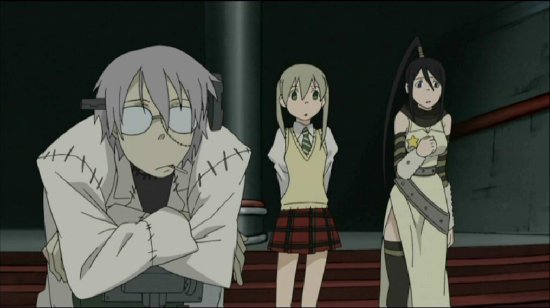
Their teacher is Dr Franken Stein. It's true that Soul Eater isn't all that original when it comes to character names, but Stein is another wonder of design and characterisation. He's the ultimate Meister, supremely confident and able, but with an inquisitive streak that goes a little too far for comfort, with a passion for dissection, and a weakness for perfection. He's still enough to put the fear into Maka's father, who used to partner with Stein before he met Maka's mother. Stein actually has a screw in his head, a massive one that he constantly tightens when he's in thought, and of course he's as covered in stitches as his namesake. The villain of the piece at this point is the manipulative witch Medusa, who is currently infiltrated into the Academy, and is experimenting on Soul trying to turn him into a Kishin Egg. It's a convoluted plot with plenty of twists and turns, and plenty to sink your teeth into.
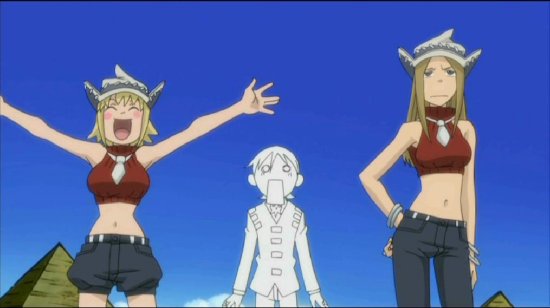
After three prologue episodes to introduce the three teams, Soul Eater follows the usual format of arc storylines interleaved with comic interludes. But even the arc stories offer much of mirth, while the comic stories also have a serious strand to them when required. And with a set length of 51 episodes, it doesn't look as if there will be any filler to take let the air out the show's tyres. Soul Eater is visually arresting, dark and comic at the same time, with an energy and pace that is almost unseemly in a show of its length. The action never stops for an instant. Best of all, it's the most fun I've had with a new anime show in months. Manga Entertainment are surely onto a winner with this show, and if there is any justice in the world, it will sell like hot cakes.
Your Opinions and Comments
Be the first to post a comment!